
"Unsteady" is not a diagnosis. It is a starting point.
Feeling unsure on your feet, or noticing that your walking has changed, is almost never one thing. It can come from muscle weakness, from joints too stiff to move through the range walking requires, from inner ear dysfunction, from a neurological condition, or from a gait pattern that quietly reorganized itself around an old injury and never reorganized back. Usually it is more than one of those at once.
Left alone, it compounds. You walk less, so you get weaker. You avoid uneven ground, so your body stops rehearsing the reactions that keep you upright. Fall risk climbs and your world gets smaller. The assessment exists to find which pieces are actually driving it, so the training goes where it will change something.
What is actually behind the unsteadiness.
Balance and walking problems come from a short list of contributors. The assessment is about working out which ones are yours, and in what proportion.
Muscle Weakness
Core and lower-body weakness leaves you no margin. When a stumble happens, the muscles that should catch you are not strong enough or fast enough to do it.
Joint Stiffness
If your ankle, hip, or spine will not move through the range that walking requires, you borrow the motion from somewhere else and stability pays for it.
Inner Ear Dysfunction
The vestibular system reports which way is up. When it underperforms, your eyes and your feet have to cover for it, and they tire.
Neurological Conditions
Parkinson's disease, stroke, multiple sclerosis, and neuropathy all change how movement gets planned and executed. Therapy targets the patterns they disrupt.
Altered Walking Mechanics
A shortened stride, a lean you did not choose, posture that drifted after an injury. Gait patterns change to protect something and then stay changed.
Lost Confidence
After a fall or a near miss, most people quietly shrink their range. Less walking means less practice, and less practice means less balance.
Balance is trainable. So is walking.
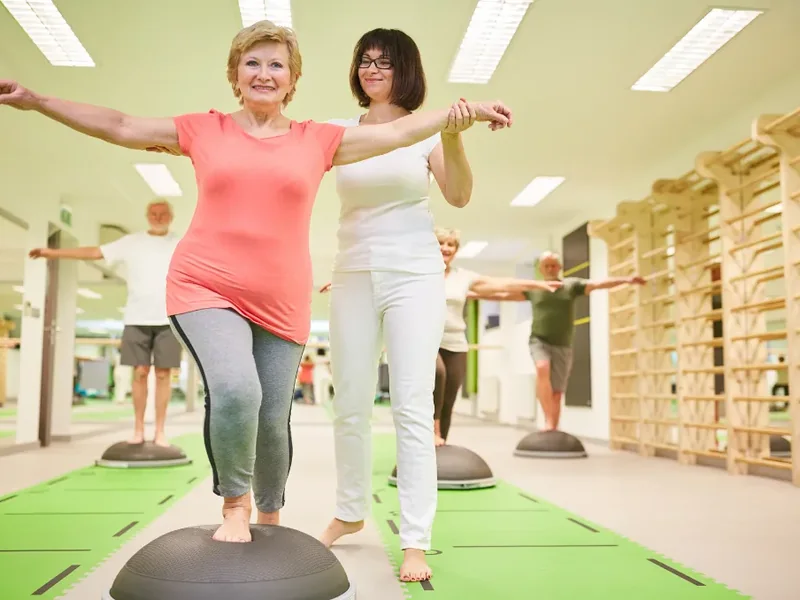
Care at Dynamic Physical Therapy starts with a thorough assessment, then builds in four parts: strength and stability, vestibular retraining, gait retraining, and fall prevention. Core and lower-body strengthening restores the support. Balance work progresses from stable ground to unstable. Coordination drills sharpen the reactions that catch you before you think about it.
Gait retraining is its own piece: walking pattern analysis to correct stride and posture, functional work to make walking less expensive, and obstacle navigation so confidence gets rebuilt where it was lost. Fall prevention closes it out with home safety recommendations, assistive device training if you need one, and strategies for the situations that make you hesitate. Dr. Matthew Nelson and Dr. Jessica Bauerkemper both hold AIB Cert-VR, the vestibular rehabilitation certification from the American Institute of Balance, which matters when the inner ear is part of the picture.
No referral needed. Utah has direct access to physical therapy. Most insurances accepted, and you see the same Doctor of Physical Therapy every visit.
Schedule Your Appointment
No referral needed. Most insurances accepted.
Your first visit runs about an hour with a Doctor of Physical Therapy who stays for all of it. Tell us where you feel unsteady, and leave with a plan.
You’re all set.
We’ll reach out within one business day to confirm your appointment. If you need to speak with us sooner, call us directly.